

Auditing Nearly 3,000 Pages to Build a Fire-Ready Website

OVERVIEW
Deepend audited an inflated, decade-old website to provide NSW Rural Fire Service with an evidence-based content strategy and authoring migration-ready content ahead of a hard fire-season deadline.
CLIENT
NSW Rural Fire Service (RFS)
INDUSTRY
Government, Emergency Services, Public Safety
SERVICES
Content Strategy, Content Audit, Content Authoring, Analytics
YEAR
2026
The Challenge
The RFS website hadn't been redesigned in ten years. Content had grown organically over that decade: information was contradictory across pages, buried in PDFs, and hard to find. Testing of the site's information architecture across 11 critical tasks with 53 participants, returned a task success rate of just 33%, and 31% of Hotjar respondents said they'd failed to achieve their goal on the site. More than half of all user feedback centred on a single page, the site's most visited. RFS was moving to a full platform rebuild on Squiz's Digital Experience Platform, with a hard deadline to be live ahead of the next fire season.
The Opportunity
A platform rebuild gave NSW RFS a rare opportunity to remedy a decade's worth of content debt in one move, provided that content decisions were made on evidence rather than guesswork.
Operationally, getting this right equated to a leaner, more managable site for RFS that stands up to legislative and operational scrutiny.
For the public, this improved content significantly; providing up-to-date, human and machine optimised content to help the community find potentially life-saving information in a timely manner.


Our Approach
Deepend structured the engagement as two deliberately separate phases: a Discovery, Audit and Content Strategy phase to decide what should be produced; followed by a Content Authoring and Reauthoring phase to produce it.
This approach meant RFS committed to full-scale content production once the plan was evidence-based, costed, and approved.
What we delivered
Analytics and voice-of-customer research

Content inventory, audit and alignment

Content creation and migration strategy

Content authoring and editorial QA

Impact

Fully comprehensive audit
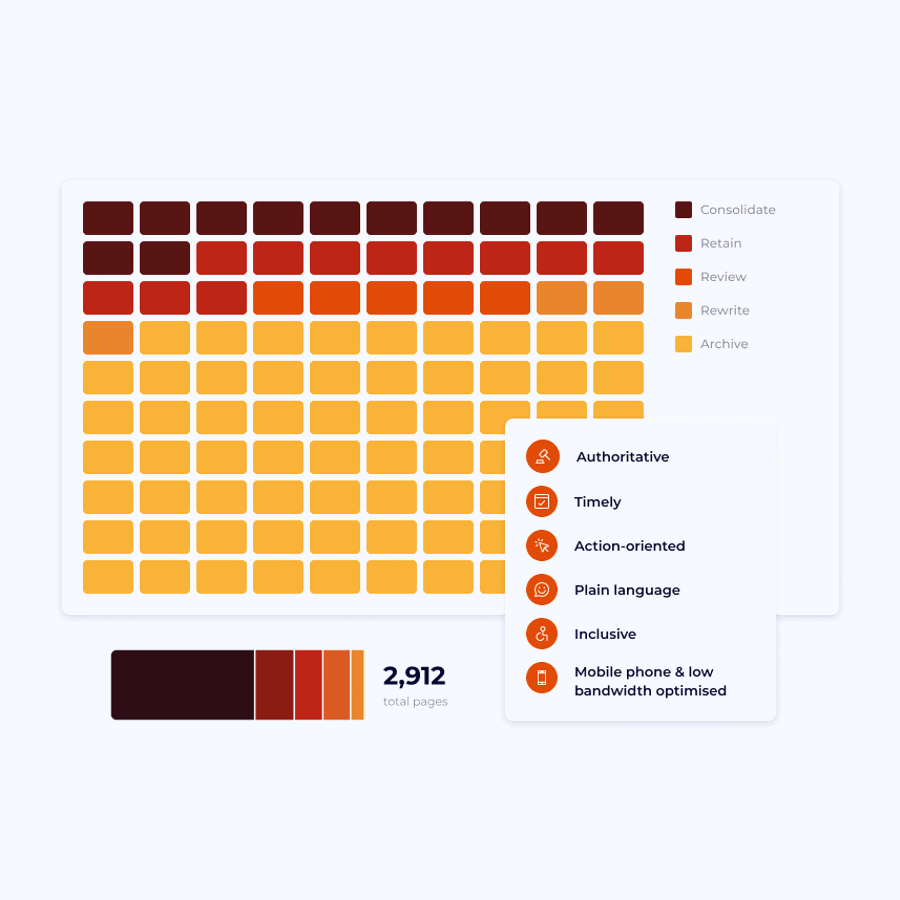
2,913 website content pages audited within a 3–4 week discovery phase.

Significant reduction in site density
69% of existing content (2,024 pages) was recommended for retirement or consolidation, cutting site complexity considerably.

Working smarter, not harder
Top 10 pages alone carried roughly 75% of all site traffic, rising to 95% across the top 50, sharpening exactly where prioritisation effort landed.

Content prioritisation matrix
50 highest-priority pages given detailed, page-level content recommendations.






-

2026
Winner Web Design and Development
Adelaide Airport
-
2024
Best in Class for Digital Design - Software & Apps
Sound Storm
-
2023
Digital Design - Apps & Software
ReachOut PeerChat
-

2023
Winner - Interact
ReachOut - PeerChat
-
2022
Digital Design - Web design & development
Royal Flying Doctor Service
-
2022
Digital Design - Web design & Development
Active Super
-

2022
Finalist for Digital Transformation Consultancy
B & T