

Transforming Public Health Data: Helping BHI Enhance Data Publishing and User Experience

Deepend helped the Bureau of Health Information improve public health data publishing by mapping governance processes, researching user needs, selecting Tableau and designing a future-state data portal.
Client: Bureau of Health Information
Industry: Government, Health, Public Sector, Data and Analytics
Services: UX research, Service design, Data governance, Platform evaluation, Information architecture, Prototyping
Year: 2018 - 2019
Overview
The Bureau of Health Information (BHI) is a NSW government agency responsible for publishing independent reports and data on the performance of the public healthcare system. One of its core functions is to provide accessible online tools for data analysis.
Deepend partnered with BHI to assess and enhance their systems and processes for publishing datasets tailored to key audience segments. This engagement produced several foundational artefacts that now support ongoing improvements in data publishing and presentation, including:
-
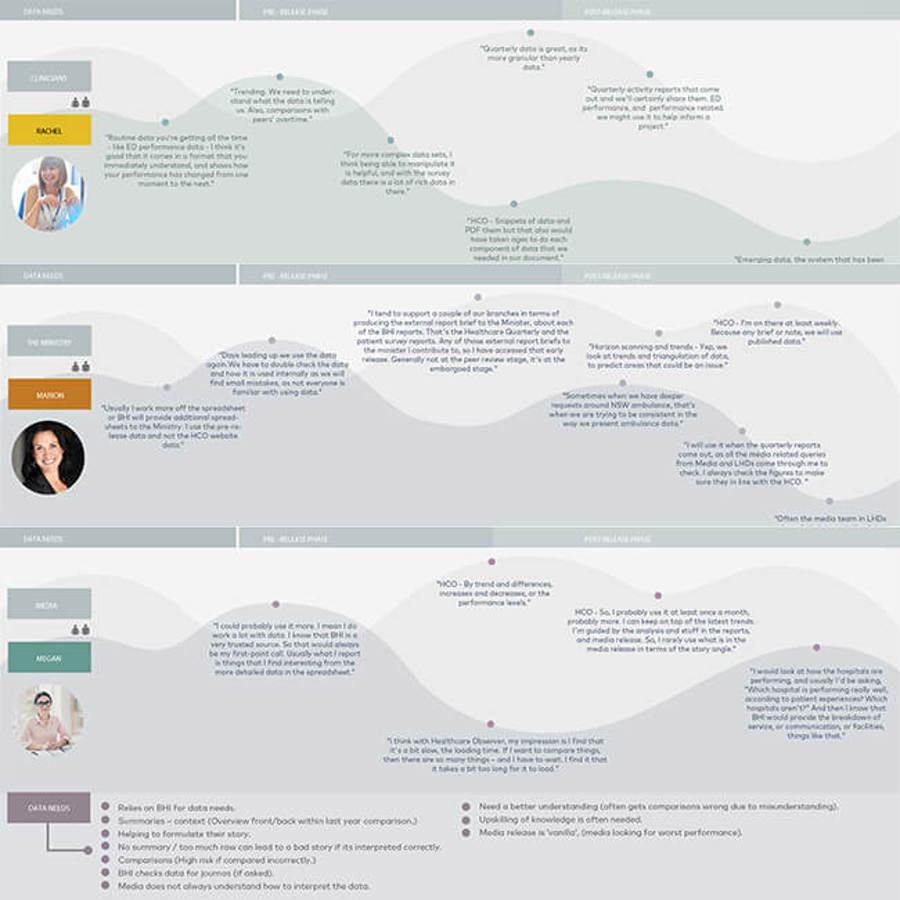
Key audience personas and journey maps
-
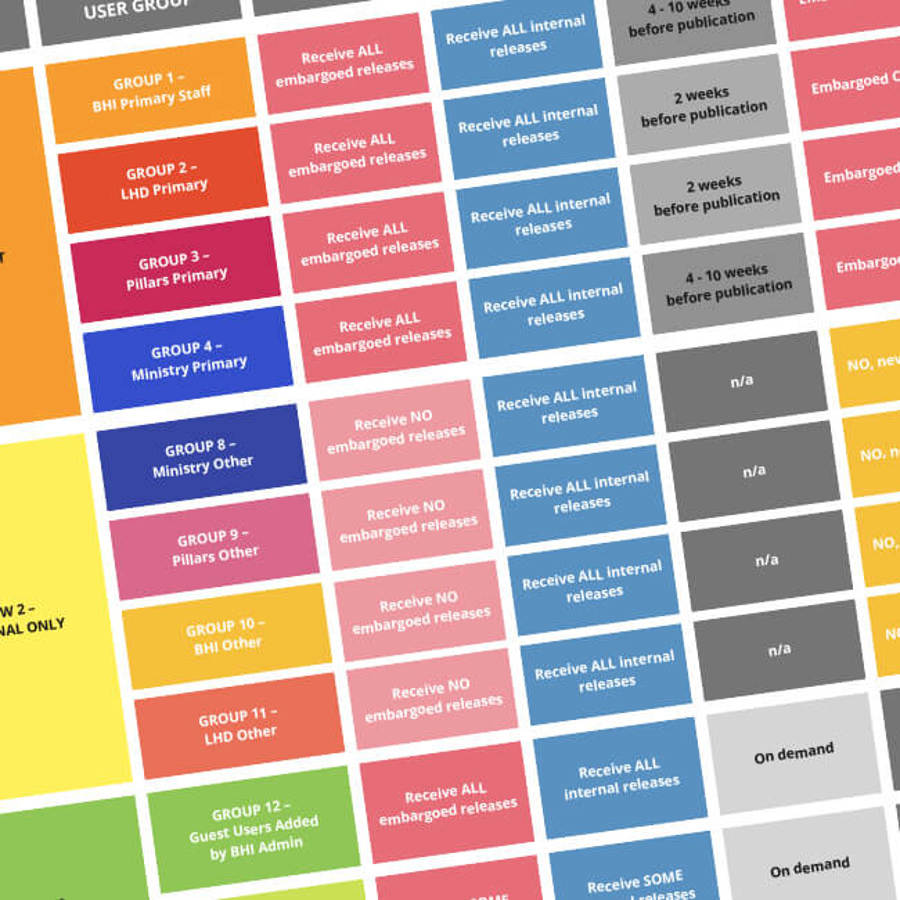
Data governance and storage models
-
Standardised naming conventions
-
Evaluation and selection of data visualisation tools
-
User experience ideation for the chosen platform
The Challenge
- BHI needed to understand and improve the systems and processes used to house, govern and publish healthcare performance datasets.
- Its audiences had different motivations, levels of data literacy and requirements, while internal teams needed clearer governance and publishing workflows.
The Opportunity
- The project created an opportunity to connect internal data governance with external user needs rather than treating publishing and experience design as separate problems.
- A structured assessment could also identify a preferred visualisation platform and define a future-state portal that BHI could develop incrementally.
Defining UX principles
Establishing key principles to hold the final Tableau execution accountable to
Our Approach
Deepend delivered the project in four phases: current-state mapping, user research and segmentation, platform evaluation, and data portal ideation.
The work combined workshops with BHI ICT and Analyst teams, interviews with key user segments, comparative platform assessment and future-state wireframing.
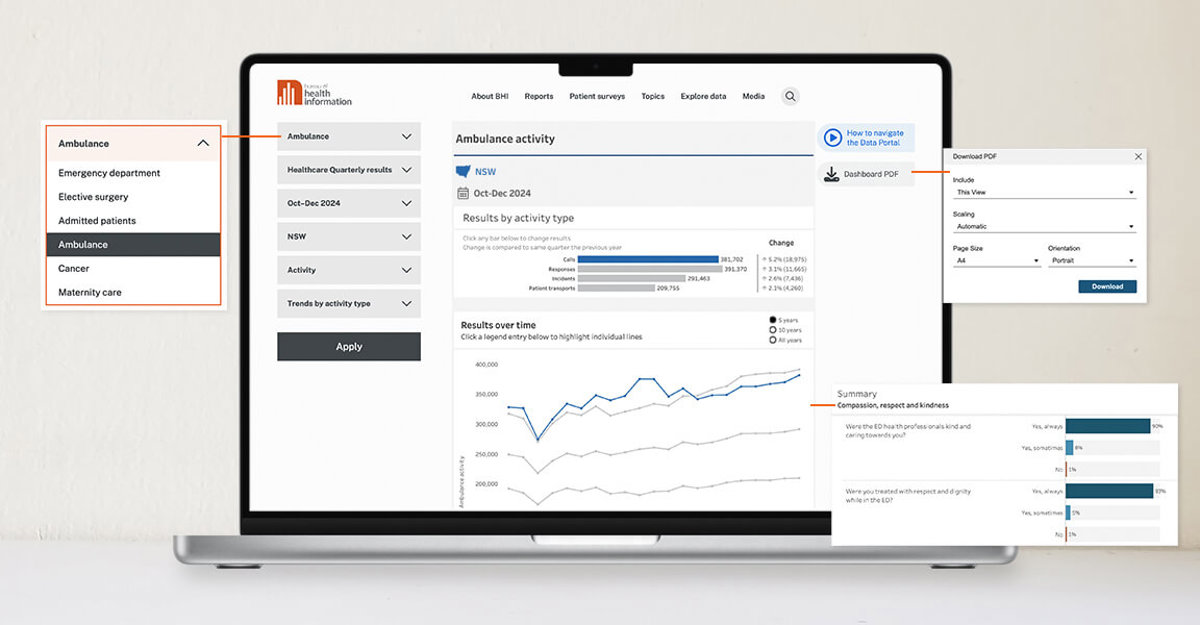
Data visualisation tool
Working closely with BHI internal resources to build out a newly ideated data portal
What We Delivered
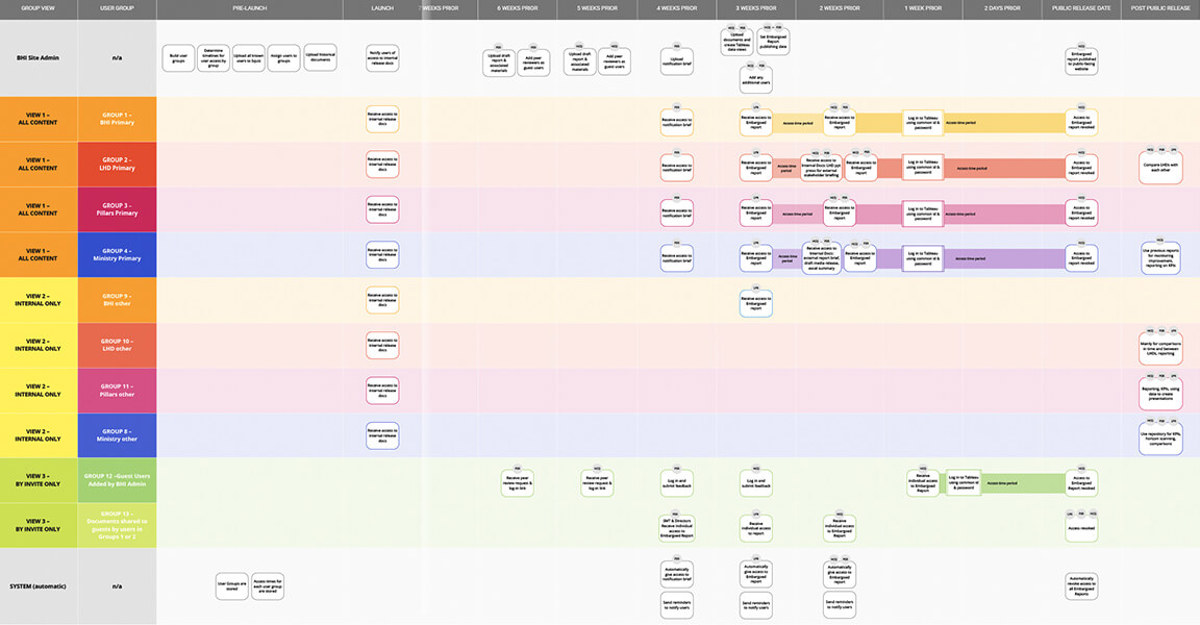
- Current-state process mapping
- Data capture, storage and access mapping
- Dataset naming convention review
- Workflow inefficiency analysis
- User research and segmentation
- Audience personas
- User journey maps
- Data governance and storage models
- Platform evaluation across Tableau, Power BI and Qlik Sense
- Tableau recommendation and validation
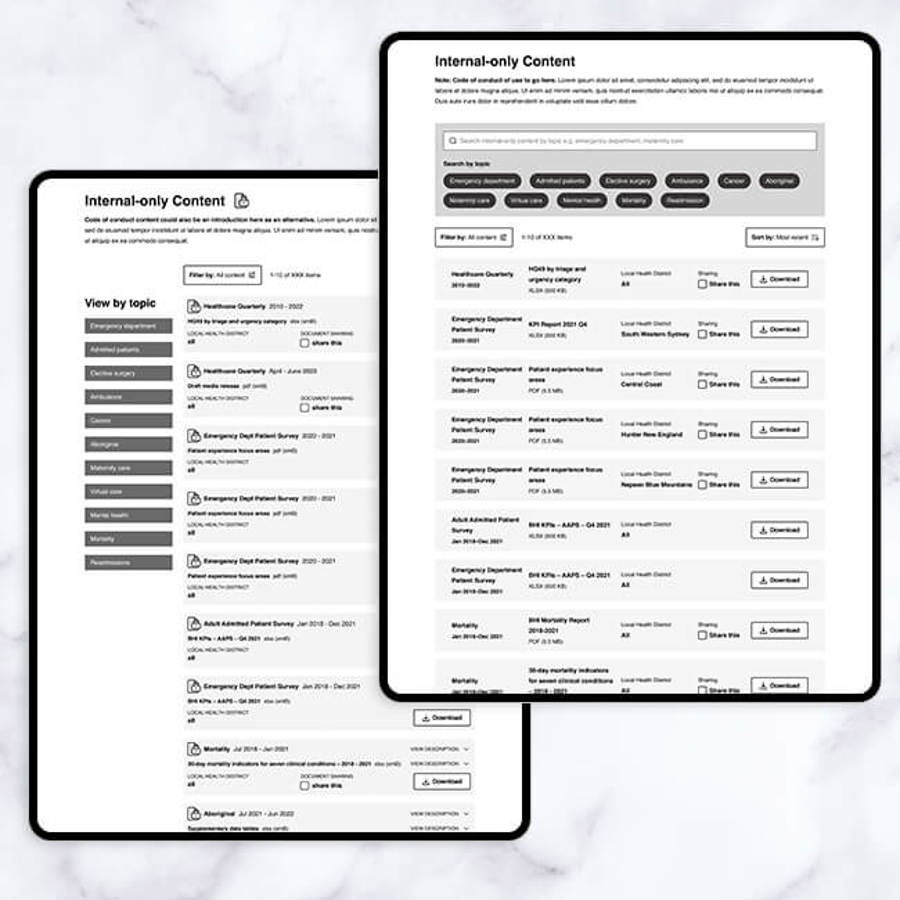
- Data portal wireframes
- Clickable prototypes
- UX principles for future implementation
- Technical feasibility assessment
Value and Impact
Data governance improvements
A comprehensive process map to guide internal data governance improvements
Deep insights
BHI datasets to understand and guide user interaction
Visualisation platform
Selection and validation of Tableau as the preferred visualisation platform
Future vision
A vision for a future-state data portal to inform incremental development
Strategy & Experience Design
Deepend interviewed representatives from BHI’s primary user segments and translated the research into personas and journey maps.
These artefacts informed portal structure, UX principles and clickable concepts showing how different audiences could interact with the same underlying data environment.
Technology & Delivery
Deepend assessed Tableau, Power BI and Qlik Sense against BHI’s functional and publishing requirements.
Tableau was selected as the preferred platform. The team then designed a future-state portal structure aligned with both audience needs and the capabilities of the chosen visualisation technology.
Results
The engagement gave BHI a connected view of data governance, user needs, platform capability and future portal design.
It established foundational artefacts for ongoing improvement and a practical vision that internal teams could use to guide incremental implementation.
Frequently Asked Questions
1. What is the Bureau of Health Information (BHI)?
BHI is a NSW government agency responsible for publishing independent reports and data on the performance of the public healthcare system, including accessible online tools for data analysis.
2. What data visualisation platform did Deepend recommend for BHI?
Deepend evaluated Tableau, Power BI and Qlik Sense against BHI's functional and publishing requirements, and recommended Tableau as the preferred platform.
3. How did Deepend help BHI improve its data governance?
Deepend mapped BHI's current-state data capture, storage and access processes, reviewed dataset naming conventions, analysed workflow inefficiencies, and produced data governance and storage models as foundational artefacts for ongoing improvement.
4. Who are the different audiences BHI's health data portal needs to serve?
BHI's audiences have different motivations, levels of data literacy and requirements. Deepend's user research produced audience personas and journey maps to reflect these different needs in the future-state portal design.
5. What did Deepend deliver as part of this engagement?
Deliverables included current-state process mapping, audience personas and journey maps, data governance and storage models, a comparative evaluation of three visualisation platforms, data portal wireframes, clickable prototypes, and UX principles for future implementation.






-

2026
Winner Web Design and Development
Adelaide Airport
-
2024
Best in Class for Digital Design - Software & Apps
Sound Storm
-
2023
Digital Design - Apps & Software
ReachOut PeerChat
-

2023
Winner - Interact
ReachOut - PeerChat
-
2022
Digital Design - Web design & development
Royal Flying Doctor Service
-
2022
Digital Design - Web design & Development
Active Super
-

2022
Finalist for Digital Transformation Consultancy
B & T