Delivering a new government website in under four weeks, with 40% greater production efficiency

Deepend delivered a new website for the Building Appeals Board in less than four weeks, demonstrating the considerable value of investing in scalable, reusable digital infrastructure.
CLIENT
Victorian Building and Plumbing Commission (BPC)
PROJECT
Building Appeals Board Website
INDUSTRY
Government, Public Sector
SERVICES
Squiz CMS, UI Design, Front-End Development, Analytics, Search Optimisation (SEO), Quality Assurance
TARGET AUDIENCES
Builders, Plumbers, Homeowners, Building Consultants, Building Developers, Lawyers, Building Inspectors
YEAR
2026
The Challenge
The Victorian Building Appeals Board required a refreshed digital presence that would maintain its distinct identity while aligning with the broader digital ecosystem of the Building and Plumbing Commission.
The challenge was to deliver a fully functioning, independently branded website within a compressed timeframe, without incurring the cost, complexity and development effort typically associated with building a new government website.


The Opportunity
Having already established a robust digital foundation for the Building and Plumbing Commission, Deepend identified an opportunity to significantly accelerate delivery by reusing existing templates, components, design patterns and technical infrastructure.
Rather than approaching the project as a standalone website build, Deepend could extend the value of the existing investment, creating a distinct digital experience while avoiding unnecessary duplication of design, engineering and testing effort.
Our Approach
Deepend adopted a reuse-first approach, deploying the Building Appeals Board website on the existing Squiz Digital Experience Platform (DXP) infrastructure.
By retaining the established information architecture, layout structures and reusable modules, the team could concentrate on brand alignment, technical configuration, quality assurance and deployment rather than rebuilding core functionality.
This approach provided the efficiencies of a shared technology foundation while maintaining a distinct visual identity for the Building Appeals Board.

PROBLEM & INSIGHT
Building once, delivering more
For government organisations managing multiple websites, traditional development approaches can result in duplicated effort, fragmented technology investments and unnecessarily high delivery costs.
The Building Appeals Board project presented an opportunity to challenge this model.
Deepend had already established a comprehensive digital foundation for the Building and Plumbing Commission, including a reusable design system, content templates, front-end components and integrated platform capabilities.
The key insight was that much of the infrastructure required to support the Building Appeals Board already existed. By treating these assets as a reusable digital capability rather than a single-purpose website implementation, Deepend could dramatically reduce the effort required to deliver a new digital experience.
STRATEGY & EXPERIENCE DESIGN
A distinct identity on a shared foundation
The strategy centred on maximising reuse without compromising the Building Appeals Board's identity or the quality of its digital experience.
Rather than undertaking an extensive redesign, Deepend adapted the established BPC design system to accommodate the Board's visual identity. Existing layout structures, content modules, navigation patterns and interface components were retained, with branding and styling adjustments applied where required.
This reduced the need for additional UX and UI design, eliminated substantial front-end development effort and provided a consistent foundation for ongoing content management.
Importantly, the approach demonstrated how a shared design system can support multiple government websites, each with its own brand identity, while maintaining common standards for usability, consistency and maintainability.
TECHNOLOGY & DELIVERY
Accelerating deployment through platform reuse
The website was deployed using the existing Squiz DXP architecture, leveraging established site structures, repositories, modules and technical configurations.
Deepend configured the new environment, implemented the Building Appeals Board's visual theme and established a dedicated Funnelback search index. Google Tag Manager and analytics tracking were also integrated to support ongoing performance measurement.
By reusing proven technical components and delivery processes, the team minimised the requirement for bespoke engineering and reduced the complexity associated with testing and deployment.
The result was a streamlined implementation that delivered the complete website in under four weeks, achieving a 40% improvement in production efficiency and enabling the site to go live three weeks ahead of schedule.
RESULTS
Greater value from existing digital investment
The Building Appeals Board website demonstrates the commercial and operational advantages of investing in scalable digital architecture.
By building upon the foundations established for the Building and Plumbing Commission, Deepend was able to deliver a distinct government website substantially faster and with considerably less production effort than a conventional standalone implementation.
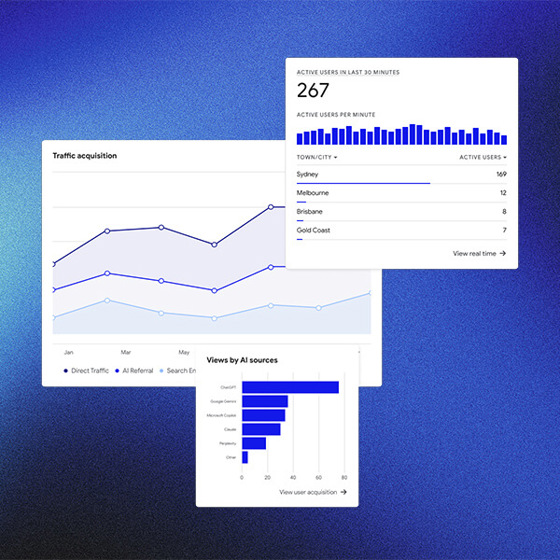
Beyond the immediate delivery efficiencies, early performance indicators have also been positive, with LLM-related traffic increasing by 60% and event tracking increasing by 3% since launch.
The project highlights a broader opportunity for government agencies and enterprise organisations managing multiple digital properties: investing in reusable design systems, shared components and scalable platform architecture can deliver compounding returns across future digital initiatives.
Rather than repeatedly funding the same foundational capabilities, organisations can direct their investment towards improving services, enhancing user experiences and responding more quickly to changing community needs.
What We Delivered
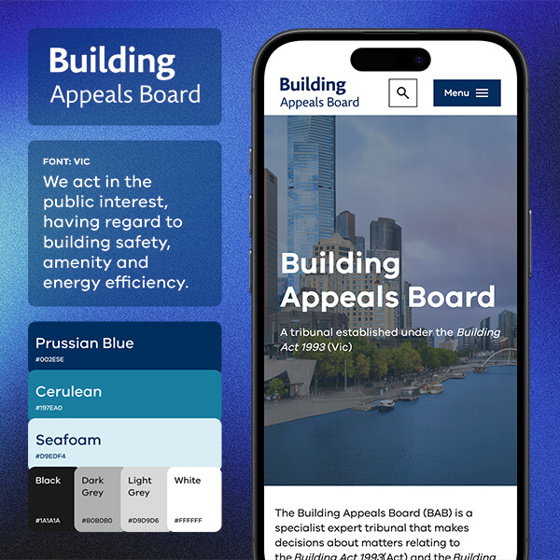
Design and brand alignment
A refreshed visual identity, incorporating the Building Appeals Board's branding, colour palette and logos within the established design system.
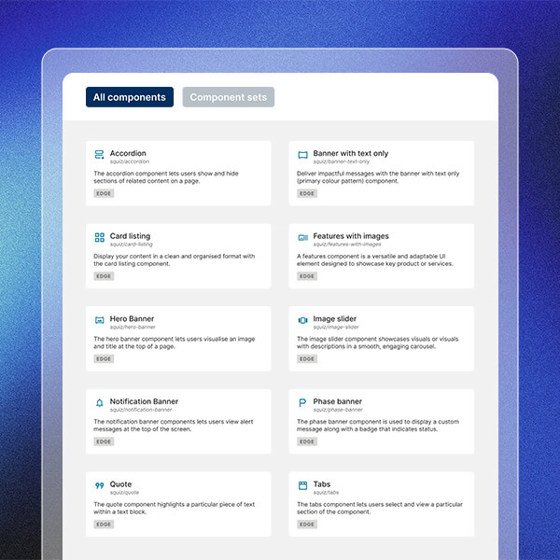
Reusable component implementation
Adaptation of existing BPC templates and modules, minimising bespoke development.
Platform configuration
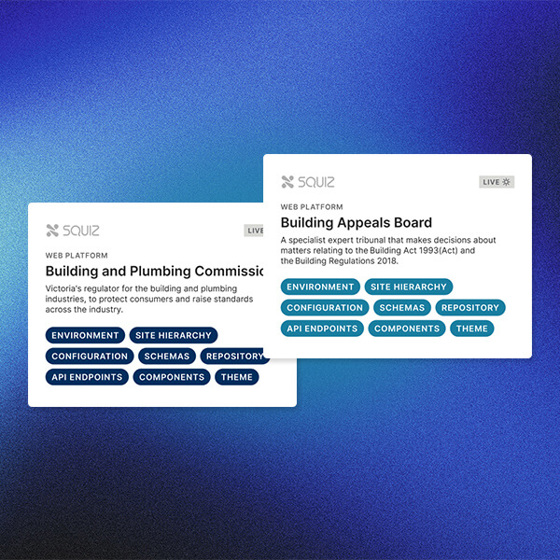
Provisioning of the new website within the existing Squiz DXP environment, including site hierarchy, schemas, repository configuration and API endpoints.
Search integration
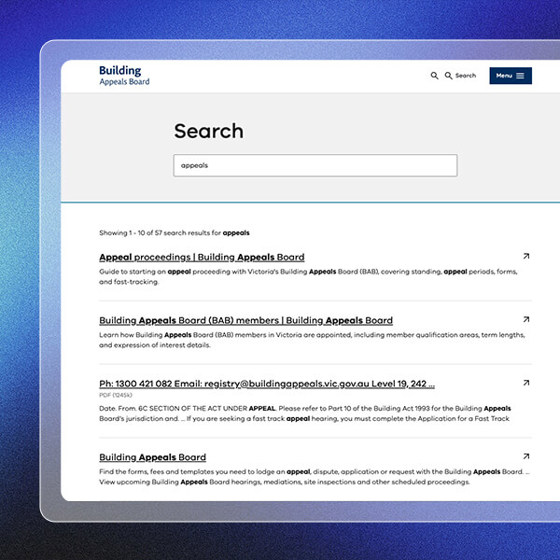
Configuration of a dedicated Funnelback search index, using the established BPC search architecture.
Analytics and tracking
Google Tag Manager integration and event tracking configuration to support ongoing performance monitoring.
Quality assurance and deployment
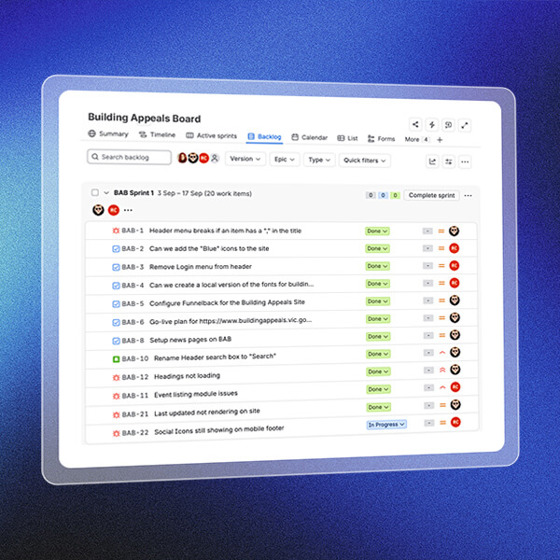
End-to-end testing, refinement and production deployment in collaboration with BPC and Squiz.
Impact

40%
Production efficiency gain through reuse of existing frameworks, templates and design systems.

Under 4 weeks
Total delivery time from project commencement to website completion.

3 weeks
Ahead of schedule due to accelerated production deployment and public launch.

+60%
LLM-related traffic. Increase in traffic attributed to AI-driven discovery.

+3%
Analytics event tracking reported increase since launch.
-

2026
Winner Web Design and Development
Adelaide Airport
-
2024
Best in Class for Digital Design - Software & Apps
Sound Storm
-
2023
Digital Design - Apps & Software
ReachOut PeerChat
-

2023
Winner - Interact
ReachOut - PeerChat
-
2022
Digital Design - Web design & development
Royal Flying Doctor Service
-
2022
Digital Design - Web design & Development
Active Super
-

2022
Finalist for Digital Transformation Consultancy
B & T
-

2026
Website Excellence in Transportation; Travel & Tourism.
Adelaide Airport
-
2026
Website Excellence in Website Redesign, Navigation, UI, Visual Appeal - Aesthetic, UX
Adelaide Airport
-
2026
Website Distinction in Structure and Navigation
Adelaide Airport