

Reframing member experience for Australia's peak medical body

Deepend helped the Australian Medical Association clarify member experience challenges, identify data and engagement gaps, define audience needs and design the foundations for a scalable member-centric website across Federal and State AMA bodies.
Client: Australian Medical Association (AMA)
Industry: Healthcare · Membership Organisations · Professional Associations · Advocacy
Services: Customer Experience · UX Research · Service Design · Data Strategy · Member Segmentation · Information Architecture · UI Design · Technical Solution Design
Year: Discovery and member experience analysis: February 2024. Website design-definition: phased programme following discovery.
Overview
The Australian Medical Association is the peak professional body for doctors in Australia. It promotes and protects the professional interests of doctors while advocating for the healthcare needs of patients and communities.
AMA had historically represented approximately 80–90% of Australian doctors. By the time of the engagement, membership had fallen to closer to 25%. Many doctors no longer saw enough value in the membership, and the experience of engaging with AMA had become harder to navigate across a federated national, State and Territory structure.
Deepend was engaged to help AMA better understand the member experience, identify data and experience gaps affecting acquisition and retention, and shape the foundations for a more personalised, cohesive and scalable digital member experience.
The Challenge
- Declining membership: Membership had fallen from historical levels of ~80–90% of doctors to closer to 25%.
- Low advocacy understanding: Advocacy remained the organisation's core product, but was widely misunderstood or perceived as relevant only to other types of doctors.
- Low member NPS: Only 29% of members were identified as promoters, with values and expectations shifting - particularly among younger segments.
- Varying engagement appetite: 67% of members wanted little to no active involvement and were happier to observe than participate.
- Fragmented experience: AMA's federated structure created inconsistent experiences across national and State bodies, making it harder to align communications, services and digital navigation.
- Data maturity gaps: AMA needed to understand what data existed, what was missing and what would be required to benchmark and improve member engagement over time.
The Opportunity
The opportunity was to move AMA from a fragmented, organisation-led view of membership toward a more member-centric model.
One that could clarify value, support different cohorts and align Federal and State priorities without removing the need for state-specific customisation.
Deepend saw the opportunity to create a shared evidence base for decision making:
- A view of priority audiences.
- Critical moments across the member journey.
- Quick-win opportunities.
- Data requirements.
- Future platform implications.
This would help AMA make more confident decisions about communications, digital information architecture, product value, personalisation and future technology investment.

Our Approach
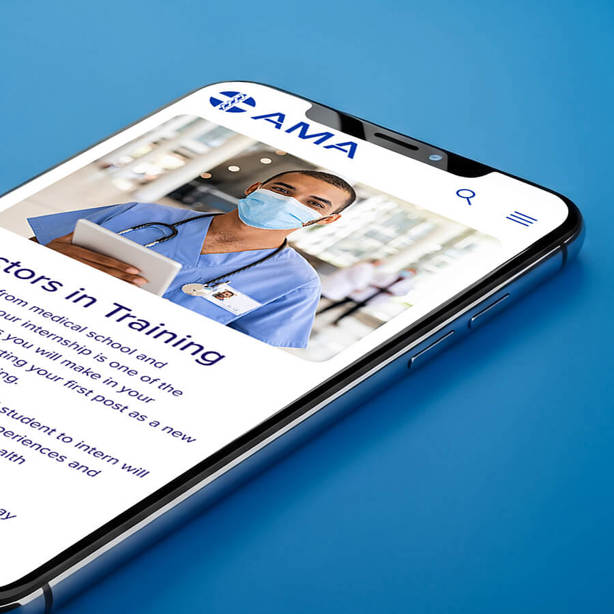
Deepend combined customer experience mapping and data analysis with member segmentation, co-design and digital experience planning. The work moved from discovery and evidence gathering through to journey mapping, opportunity prioritisation, data requirements, user research, technical solution design, information architecture, wireframes and UI design.
Digital Experience Design
The approach was deliberately practical: lean enough to avoid diminishing returns from current-state analysis, but structured enough to generate a clear roadmap for near-term improvements and future-state digital experience design.
What we delivered

Customer experience mapping
Mapped the current member experience, identified priority gaps and created a shared view of current-state opportunities.

Data analysis and requirements
Reviewed available data sources, assessed high-level data health and identified data and functional gaps required to support future personalisation, platform choice and CX benchmarking.

Member segmentation
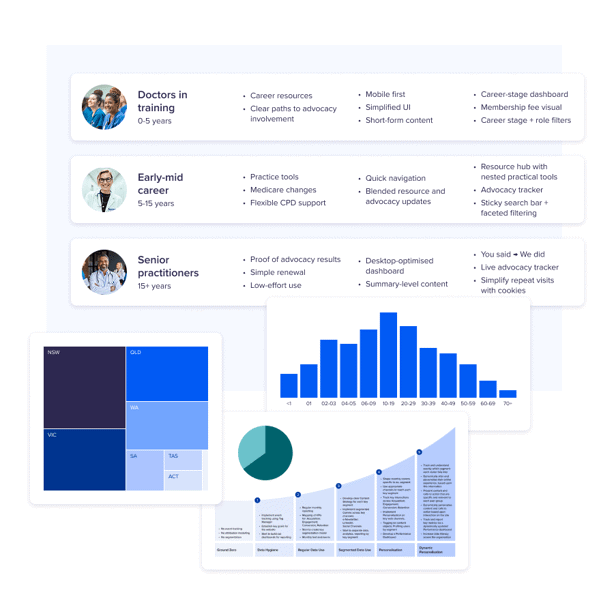
Clarified priority audience segments based on career stage, practice setting and engagement needs.

Member engagement co-design
Researched four key member cohorts and worked with AMA stakeholders to shape engagement streams informing future communications strategy, information architecture and website design.

Member experience report
Developed hot spot opportunities, segment snapshots, insight platforms, experience demos and a landscape audit.

User research
Designed research approach, discussion guides, participant communications, external user research workshops, personas, journey maps and outcomes reporting.

Technical solution design
Reviewed solution architecture, created component inventory, hosting and infrastructure considerations, cybersecurity design and a lightweight functional specification.

User experience and IA
Conducted SEO, content and performance audit, refined the information architecture and developed wireframes for key templates.

Interface design
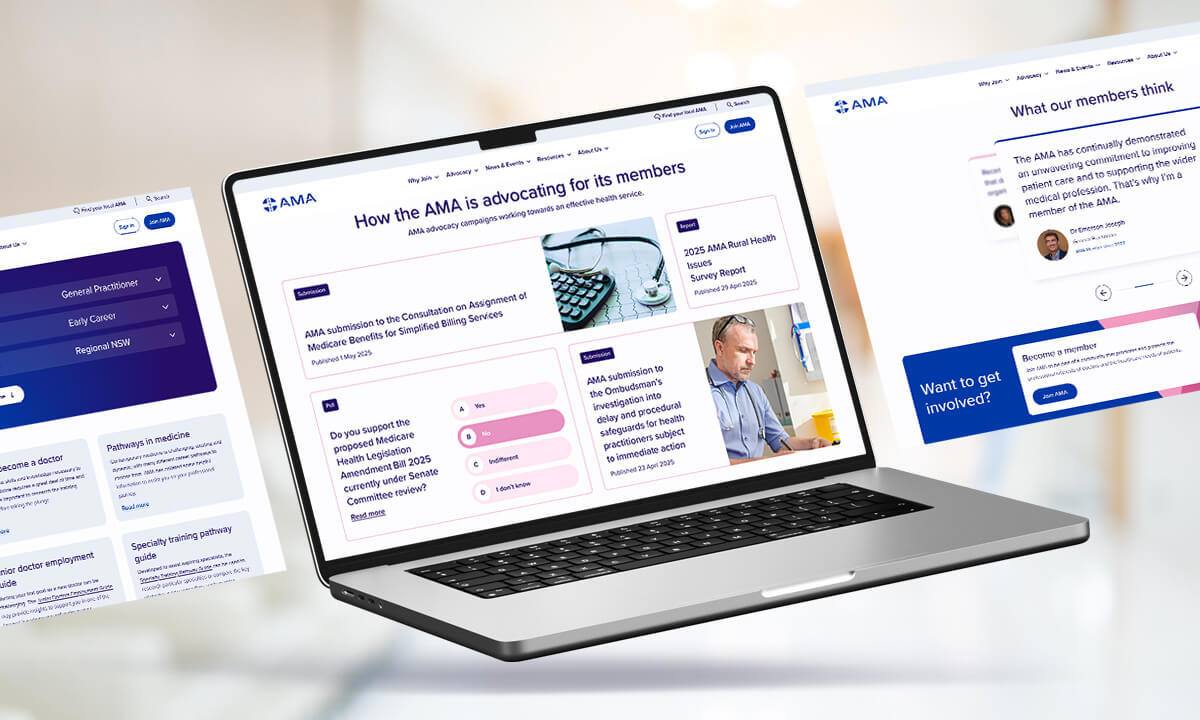
Created UI concept directions and applied the approved direction across selected desktop and mobile page designs.
Problem & Insight
AMA's central challenge was not simply digital usability or communications performance. It was a broader relevance problem: many doctors did not clearly perceive the value of membership, even though AMA's advocacy role remained critically important. The work revealed that advocacy was the core but underappreciated product, and that member expectations were shifting - particularly among younger cohorts.
The key insight:
the member journey across acquisition and retention – including trigger events, awareness, discovery and evaluation, enquiry, eligibility, application, onboarding, ongoing engagement, renewal and advocacy. Mapping these moments made it possible to see where members encountered friction, where expectations were unclear and where engagement could be improved through better service design, communications and digital support.
The audience view also needed to become more precise. Deepend focused on stages of practice—medical students and interns, doctors in training, senior medical officers, GPs and specialists—as well as practice settings including public, private, owner-operated and rural or regional contexts. This segmentation helped AMA recognise that a single generic member experience could not serve all doctors equally well.
Strategy & Experience Design
Deepend's strategy was to connect member insight to practical experience and platform decisions.

Digital Experience Prioritisation
Hunch workshops, stakeholder interviews and sensemaking activities helped identify priority experiences to map, including sign-up, onboarding and advocacy engagement.
Strategy & Experience Design
Deepend's strategy was to connect member insight to practical experience and platform decisions. The engagement began by forming a cross-functional AMA-Deepend project team and aligning stakeholders around the priority engagement challenges. Existing documents, research, audience insights and engagement performance data were reviewed to identify what was already known and where the most important knowledge gaps remained.
Hunch workshops, stakeholder interviews and sensemaking activities helped identify priority experiences to map, including sign-up, onboarding and advocacy engagement. The team assessed the experience through functional, emotional and social lenses, then prioritised hot spots and moments of truth where AMA could most improve relevance and ease of engagement.
The output was designed to drive action. Rather than producing a static current-state map, Deepend created artefacts that could guide decisions: hot spot opportunity summaries, segment snapshots, insight platforms, experience demos and a landscape audit. These helped leadership and stakeholders see the member experience more clearly, compare opportunities against best-in-class examples and agree on next steps for a more personalised member engagement experience.
Designed for member-centred transformation
Deepend gave AMA the foundations for a more practical way to connect advocacy, community, professional support and digital experience.
Technology & Delivery
The data stream focused on understanding the existing data landscape and identifying what would be needed to support future-state member engagement. Deepend reviewed likely data sources - including CRM, event attendance, website analytics and email marketing platforms - then assessed the quality, structure and relevance of available data.
The objective was not detailed data cleaning. The focus was to understand data health, identify duplication and completeness issues at a high level, and define data and functional gaps that future technology or platform decisions would need to address. This included requirements relevant to customer data platform or business intelligence platform decisions, as well as the data architecture needed to support personalisation and engagement measurement.
The later website-focused phases translated strategic and research foundations into a concrete delivery pathway: technical solution design, component inventory, hosting and infrastructure design, cybersecurity design, a lightweight functional specification, information architecture, wireframes, UI concept directions and selected desktop and mobile UI designs.
Results
Deepend gave AMA a clearer foundation for member-centred transformation. The work created a shared understanding of current member experience issues, priority cohorts, data gaps, digital requirements and future-state opportunities.
By the end of the design-definition phase, AMA had the foundations for:
- A scalable member-centric website.
- A cohesive design system aligned to member needs.
- State-specific customisation and federal priorities.
- A prioritised scope for Release 1.
- A backlog for future enhancements.
- A roadmap that improved transparency around development effort, timelines and budgets.
Most importantly, the engagement gave AMA a more practical way to connect advocacy, community, professional support and digital experience – establishing the evidence base and design framework needed to improve how doctors discover value, engage with services, participate in advocacy and renew their relationship with AMA over time.





-

2024
Best in Class for Digital Design - Software & Apps
Sound Storm
-
2023
Digital Design - Apps & Software
ReachOut PeerChat
-

2023
Winner - Interact
ReachOut - PeerChat
-
2022
Digital Design - Web design & development
Royal Flying Doctor Service
-
2022
Digital Design - Web design & Development
Active Super
-

2022
Finalist for Digital Transformation Consultancy
B & T